
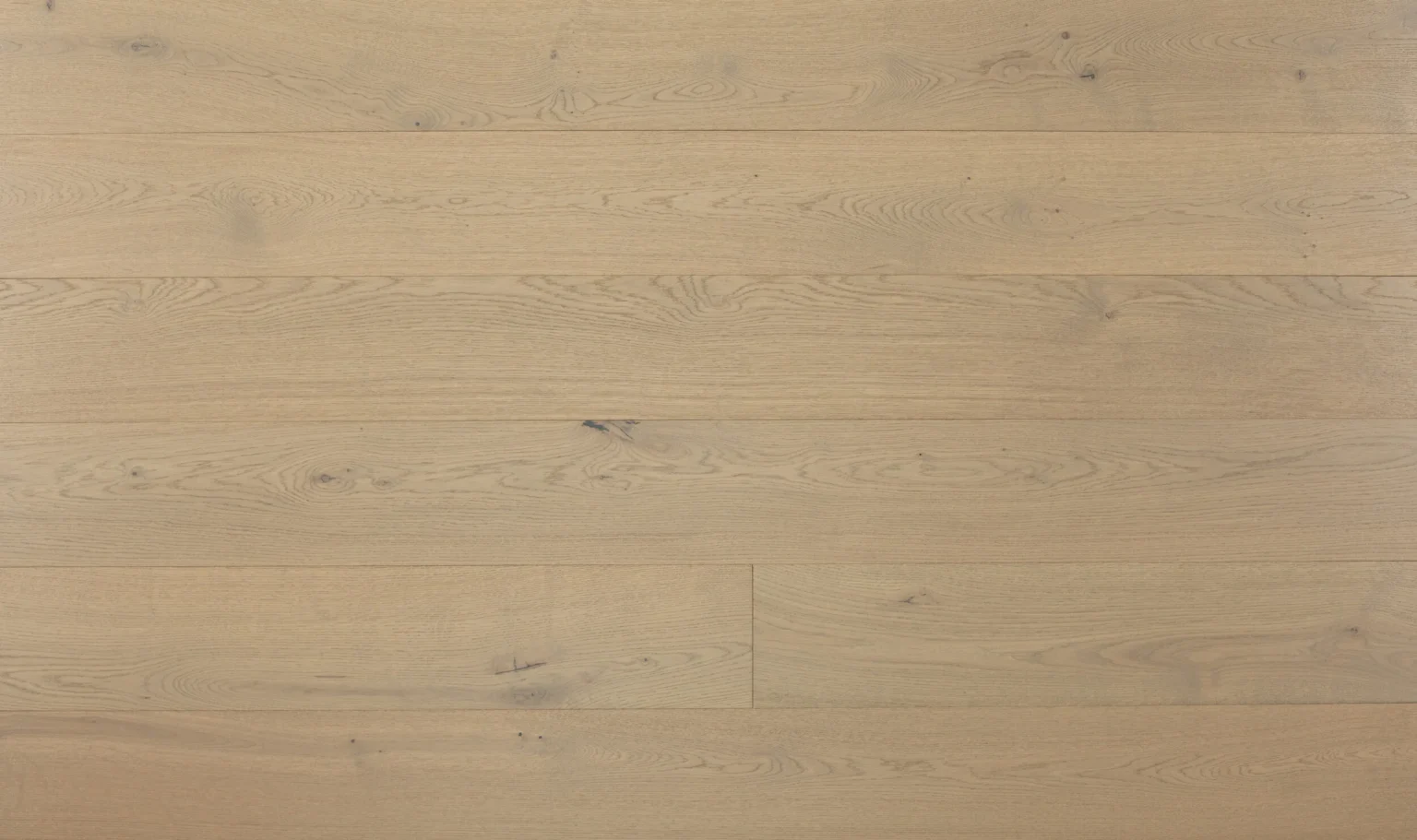
The same European oak plank can come to you two ways. In one box it is already sanded, colored and coated at the factory; in the other it arrives bare, and the finishing happens in your house after the boards are down.
That is the real difference in prefinished vs unfinished hardwood: not the wood, but where and when the finish goes on.
Choose prefinished if you are living in the home, want the room back quickly and want a finish warranty from the flooring maker. Choose unfinished if you need to match an existing site-finished floor, want a custom stain or sheen, or want a flat surface without beveled seams, and you can give up the room for the finishing days.
The short answer: it’s about where and when the finish goes on
Prefinished hardwood is flooring whose stain and protective coats are applied in the factory, so the job on site is installation only.
Unfinished hardwood is bare wood: it is installed first, then sanded and finished in place. Both can be real hardwood, and in our catalog both routes exist in engineered construction, the type we stock for engineered hardwood flooring in Charleston SC and Richmond. Unfinished flooring is also made in solid hardwood; the plank we stock unfinished is engineered.
Everything else in this guide follows from that one fact: edges, color choice, who warrants the finish, how long the room is out of use and what the quote includes.
Prefinished and unfinished side by side
| Prefinished | Unfinished (finished on site) | |
|---|---|---|
| Where the finish is applied | At the factory, before boxing | In your home, after installation |
| Edges | Usually beveled: micro bevel on Chesapeake Points East and Cromwell, a four-sided micro bevel on PermWood LaBelle | Sanded flat together on site, so there are no bevel lines between boards |
| Color and sheen | Picked from the line’s colors and sheen | Picked on site: stain, sheen and finish system |
| Who warrants the finish | The flooring manufacturer, with a stated term per line | The finish product and the crew that applies it; ask who stands behind it |
| Work in your house | Installation only; on Chesapeake floating installs, furniture after 12 hours and heavy objects or full traffic after 24 | Installation, sanding, color, finish coats and cure, on the finish maker’s dry and cure times |
| Daily care | Use the cleaner the maker specifies for that finish; Chesapeake, for example, allows an approved hardwood cleaner on urethane and aluminum-oxide finishes and rules out wet mops and steam mops | The same habits, with care products matched to the finish system chosen on site |
| Sanding dust and finish fumes indoors | None from finishing | Part of the job |
| Best fit | Occupied homes, tight schedules, rooms that must reopen fast | Matching existing site-finished floors, custom colors, a flat continuous look |
What a factory finish looks like on the boards we carry
“Prefinished” covers two families of finish, and each line spells out its own on our product pages. Read the finish line and the warranty line together, then ask for that line’s care guide, because each family takes its own cleaning products.
Urethane-type finishes, cured at the factory and in some lines reinforced with aluminum oxide:
- Aged Wide Floors Designer and Hamptons collections: Bona UV Traffic over a lightly wire-brushed face, in a smooth matte sheen on the Designer Collection in Milan.
- Denali collections: UV urethane with aluminum oxide.
- Chesapeake: a UV-cured finish on Cromwell with a 25-year finish warranty; urethane with aluminum oxide on Chemistry; aluminum oxide on Estuary.
- Veranda Asheville: 100% urethane.
Oil and oil-look finishes:
- Hallmark Ventura and Alta Vista: Nu Oil finish, sold with a lifetime structural and residential finish warranty, as on Ventura Dune Oak.
- Veranda Charleston: a high-penetrating transparent base for a true oil look.
One line names its sheen and wear warranty rather than the chemistry: Symphony, a brushed matte at a 5% to 7% gloss level with a 50-year wear warranty, as on Symphony Basso.
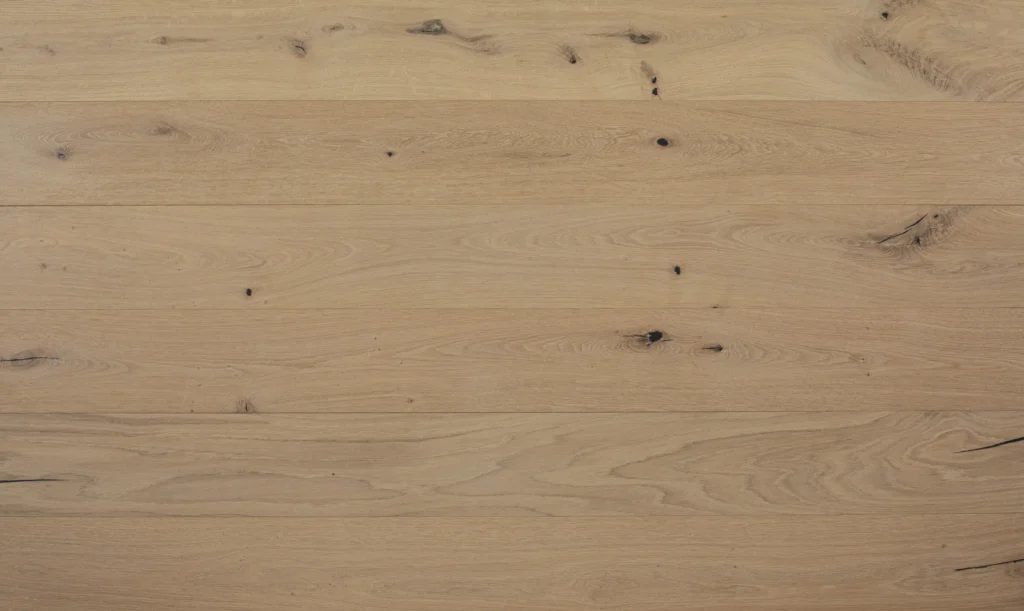
The Milan boards above came from the factory finished: the pale matte color is the coat, and each board’s edge shows as a fine line where it meets the next.
What an unfinished, pre-sanded plank is
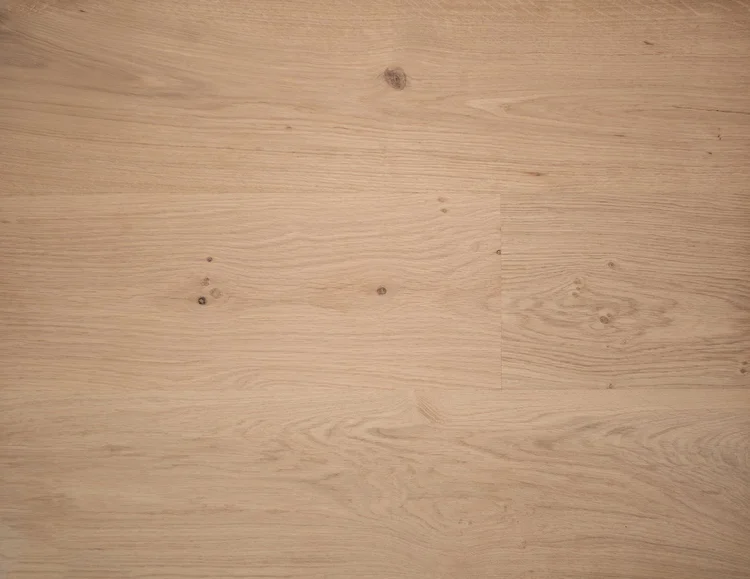
Yes, you can buy unfinished hardwood flooring. Ours is the Aged Wide Floors Legacy European Oak, Unfinished / Pre-Sanded: engineered, 5/8 inch thick and 7-1/2 inches wide, with a 4 mm wear layer of oak on top.
As the name says, the face leaves the mill sanded but bare. Color, sealer and finish coats are applied on site once the floor is installed. If you like the plank but not the extra steps, the Legacy collection is also sold in factory-finished colors and in a herringbone format.
When the unfinished route earns its extra days
- You are adding to a floor that was finished on site. New boards can be colored and coated to match its color and sheen.
- No factory line offers the color or sheen you have in mind.
- A flat, continuous surface matters to you. With no bevel lines between boards, the floor reads as one plane and there are no grooves at the seams.
- The house is under construction anyway, and the floor can be finished near the end of the job.
When prefinished is the better call
- You live in the house. Nothing is sanded or coated indoors, and the room comes back as soon as installation and any adhesive cure times allow.
- A finish warranty with a number on it, issued by the company that applied the finish, is worth more to you than a custom color.
- Your schedule is tight: installation is the whole job.
Prefinished floors need protecting during a build, though. Chesapeake asks that all wet work be finished first and that wood flooring be one of the last items installed. It also warns that tape on the surface can leave residue or harm the finish, and that damage from tape voids the finish warranty.
Humidity, acclimation and the finishing window
Both routes start the same way. Chesapeake wants the HVAC running for at least 14 days before installation, with the rooms between 60 and 80 °F and relative humidity between 35% and 55%.
The flooring then acclimates on site for at least 72 hours, raised four inches off any on-grade concrete. Our guide to acclimating engineered hardwood walks through those steps.
With unfinished boards, the sanding and finishing days come on top of that, so plan for the same indoor conditions to hold until the last coat has cured.
What decides the price of each route
Comparing the two routes by the box alone misleads, because the unfinished box leaves part of the work for later. What moves each quote:
- Prefinished: the line, width and grade; the installation method (nail, staple, glue or float); subfloor prep; square footage plus waste (Chesapeake suggests 5% for engineered).
- Unfinished: the same, plus on-site sanding, stain or color, the finish system and number of coats, and the extra days of labor.
- Both: moldings, stairs and transitions, and whether furniture has to be moved out and back.
To see both routes side by side, including the Legacy pre-sanded plank and our factory-finished lines, browse our engineered hardwood collections and book a visit to the North Charleston or Richmond showroom.
Sources: product specifications on TRD Floor Supplies product pages (finish, edge, warranty); Chesapeake engineered hardwood installation guidelines and engineered hardwood warranty and hardwood care and maintenance guidelines (rev. 6/1/2025).


0 Comments