
To choose flooring, answer six questions in order: how much water the room sees, what is underneath, how hard the floor will be used, whether it must be real wood, whether there is radiant heat or heavy built-ins, and how it will be installed.
Each answer rules out options, and the spec sheet of the product that is left settles the details.
We built this path from the manufacturer documents behind the lines on our shelves at TRD Floor Supplies, so every rule below points to a real sheet you can ask us for.
Question 1: How much water will this room actually see?
Start with water, because it removes the most options at once. A bedroom sees an occasional spilled glass. A full bathroom, laundry room or mudroom sees mopping, splashes and the odd appliance leak.
For wet rooms, rigid-core luxury vinyl (SPC) is the usual starting point. PermShield, one of the SPC brands we carry, describes its floors as waterproof from topical moisture when properly installed, and its installation manual also says not to install them where water stands frequently.
The laminates we stock are sold as waterproof too, yet Chesapeake’s laminate installation guide notes that the floor is not a moisture barrier and covers topical moisture for 24 hours.
So the label narrows the field, and the manual tells you the limits. Our waterproof lines are the ones to compare for kitchens, baths and laundry rooms.
Question 2: What is underneath the new floor?
The subfloor decides which products are even allowed. Manufacturers rate each line for on-grade, above-grade or below-grade use, and the ratings differ inside the same brand: Chesapeake lists its Points East engineered hardwood for on, below or above grade, and its Cromwell line for on or above grade only.
Concrete brings its own conditions. PermShield requires a 6-mil polyethylene sheet under its floating floors on concrete that is on or below grade, while Chesapeake’s laminate guide calls for that sheet when a concrete moisture meter reads above 4.0. Tell us what is under the old floor before you fall for a sample.
Question 3: How much traffic and wear will it take?
Each floor type states durability in its own unit, so compare like with like:
- Laminate: the AC rating. Both lines in our laminate collection, Chesapeake All American Premium and Fusion Design XL, are listed as AC4, light commercial.
- Luxury vinyl: the wear layer in mils. Our luxury vinyl and SPC planks run from 12 mil (Belocore SPC) to 20 mil (PermShield Lite) and 22 mil (PermShield One Plus).
- Engineered hardwood: the factory finish and the thickness of the real-wood top layer, covered in the next question.
An entry hall used by a family with a dog and a home office with a rolling chair stress a floor differently. Name the use, then read the number that matters for that type.
Question 4: Does it need to be real wood?
If the answer is yes, the choice is engineered hardwood: a real wood top layer bonded to a layered core, which handles humidity changes better than a single solid board.
Across the engineered lines we carry, that top layer ranges from 1.8 mm (Denali Tribeca) to 6 mm (Denali Apogee Fengari), with 3 mm and 4 mm options in between from Aged Wide Floors, Chesapeake and Symphony.
A thicker top layer leaves more wood to work with over the life of the floor. Real wood also asks more of the house: Chesapeake and Denali both ask owners to keep indoor relative humidity between 35% and 55%. Browse the engineered hardwood collections with that range in mind.
Question 5: Is there radiant heat or a heavy island going on top?
Radiant heat approval is listed line by line, not by floor type. All American Premium laminate is marked radiant-heat approved and Fusion Design XL is not; Points East engineered hardwood is approved. Chesapeake’s laminate guide adds that the heated subfloor surface must never exceed 80°F.
Weight matters on floating floors, which are not fastened down and need room to move. Both Chesapeake and PermShield say cabinets and islands go in before the floor and are never set on top of it.
Chesapeake also caps furniture on its laminate at 400 pounds, evenly distributed, with no single point load above 100 pounds. If a heavy appliance or a built-in is part of the plan, ask about it before you pick the product.
Question 6: Who will install it, and how?
Click-together floating floors, such as our laminates with the Uniclic locking system and the SPC planks, suit a careful DIYer with a tapping block and a pull bar. Engineered hardwood is installed according to its own sheet: the Denali lines we carry are glued down or glue-assisted nailed down, while Chesapeake Cromwell allows glue, nail, staple or float.
The method changes the subfloor prep, the tools and the timeline, so match it to whoever is doing the work. We answer installation questions by phone in English, Spanish and Portuguese.
The four floor types we stock, side by side
This table condenses the spec sheets and manuals of the lines on our shelves. Waterproof flooring is not a separate material: it is the SPC and laminate lines sold with a waterproof claim.
| Engineered hardwood | Laminate | Luxury vinyl (SPC) | |
|---|---|---|---|
| What it is | Real wood top layer on a layered core | Printed design under a wear layer on a fiberboard core | Rigid stone-plastic composite core with a vinyl wear layer |
| Examples we carry | Denali, Chesapeake, Aged Wide Floors, Hallmark, Sienna, Symphony | Chesapeake All American Premium (7.48″ x 47.24″), Fusion Design XL (9.3″ x 72″) | PermShield Lite and One Plus, Belocore SPC |
| Durability figure | Top layer 1.8 to 6 mm; factory finish | AC4; 12 mm total (10 mm + 2 mm attached pad) | 12, 20 or 22 mil wear layer; 1 or 1.5 mm attached IXPE pad |
| Water, per the maker’s documents | Indoor humidity kept at 35–55% | Topical moisture up to 24 hours; not a moisture barrier | Waterproof from topical moisture; not for frequent standing water |
| Where it can go | Line by line: on/above grade, some below grade | All grade levels, with a 6-mil sheet over damp concrete | On, above or below grade, with a 6-mil sheet on concrete at or below grade |
| How it installs | Glue, nail, staple or float, as the sheet allows | Click, floating | Click, floating |
What changes the price (no price tags here)
We don’t publish prices because they change, but the factors are stable. Cost moves with the collection and species, the thickness of the top or wear layer, plank width and length, the finish, and whether the product is in stock or ordered.
Quantity matters as much as the price per box. Chesapeake tells installers to add 10% to the room size for cutting waste on laminate and 5% on engineered hardwood, plus moldings such as quarter round or stair nose where needed. Bring the room measurements and we will put the numbers on a quote.
What to bring to the showroom
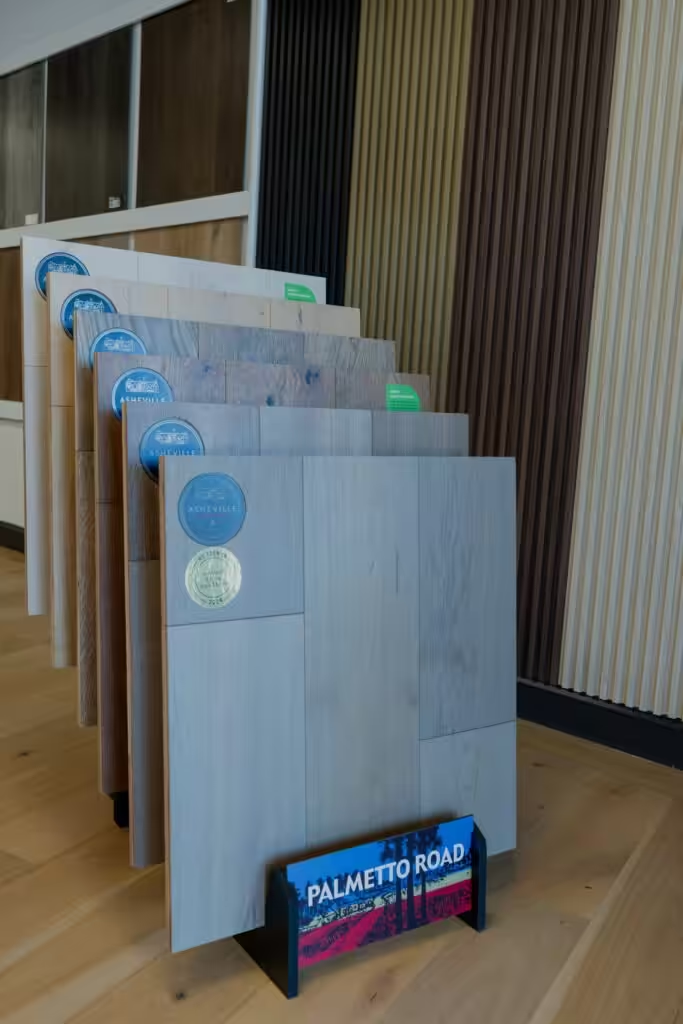
A short visit settles what a spec sheet can’t, such as color under real light and how a plank feels underfoot. Bring:
- Room measurements and a few photos, including the doorways where the new floor meets the old one.
- What is underneath: plywood, a slab, or an existing floor.
- Any radiant heat, cabinets or islands planned on the floor.
- Your answers to the six questions above.
You can take samples home and see them in your own light before you decide. Our showrooms in North Charleston and Richmond are open Monday to Friday from 6 a.m. to 5 p.m. and Saturday from 6 a.m. to noon. Schedule your showroom visit and tell us which room you are planning first.
0 Comments