
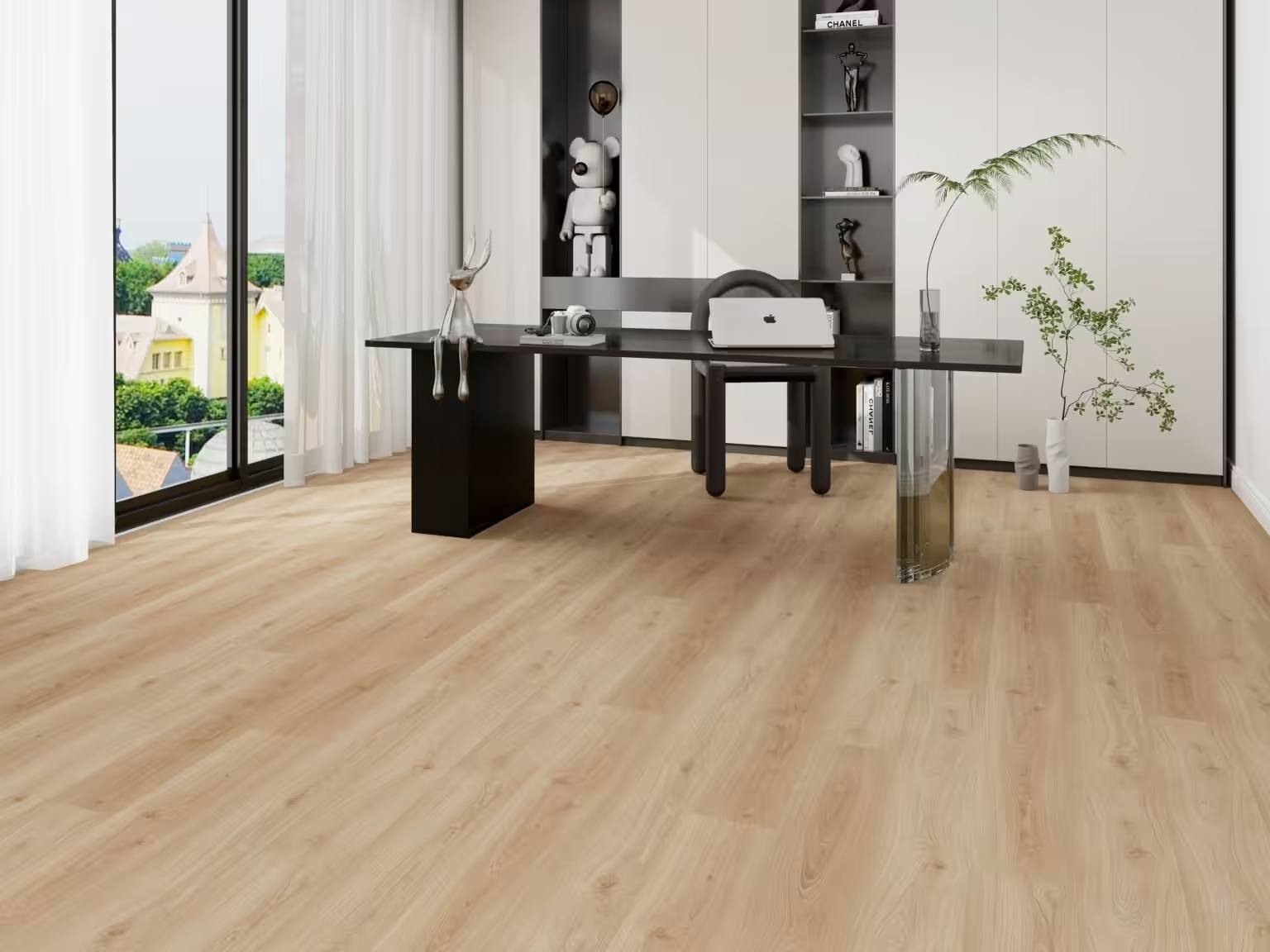
The most common mistake with waterproof vs water-resistant flooring is buying on the word printed on the box. The word tells you how the core reacts to water. The installation manual and the warranty tell you how much water, for how long and where, and that is where the two labels really separate.
The short answer: it comes down to the core and the paperwork
Water-resistant flooring handles spills for a limited time before water can reach a core that swells; waterproof flooring has a core that does not swell when wet.
Neither one is a moisture barrier for the subfloor, and in the manuals we checked, “waterproof” is written for topical water such as spills, mopping and pet accidents, not for floods or standing water.
Traditional laminate is the classic water-resistant floor. The European laminate producers’ association EPLF notes that its core layer is made of wood, so water that gets into the joints makes them swell. Rigid-core SPC vinyl, with a stone-plastic composite core, is the classic waterproof floor.
Myth 1: A waterproof floor makes the room waterproof
Fact: the floor’s core can shrug off water while the room around it cannot. Chesapeake’s laminate installation guidelines say the floor “is not a moisture barrier,” and that prolonged moisture in the subfloor and the environment can lead to mold and moisture damage.
The warranty follows the same line. It does not cover damage to the subfloor, walls, fixtures, moldings or anything that is not the floor plank. A leak that runs under the planks is a subfloor problem first.
Myth 2: Standing water is fine on a waterproof floor
Fact: the manuals plan for spills, not pools. The PermShield installation manual (revised September 2023), which covers the SPC luxury vinyl lines we stock, says the floor is waterproof from topical moisture when properly installed. The same manual says not to install it in areas subject to frequent standing water or in high moisture areas.
On the laminate side, Chesapeake’s warranty excludes damage from floods, plumbing or appliance leaks and exposure to standing water. If you plan a waterproof floor next to a washer, a water heater or a dishwasher, plan the leak detection and the drip pan too.
Myth 3: The box and the warranty use the same word
Fact: on the same product, they may not. Here is a real example from the laminates we carry, Chesapeake All American Premium and Fusion Design XL:
| Where you read it | What it says |
|---|---|
| Sell sheet headline | “10+2mm Waterproof Laminate” |
| Sell sheet, warranty line | “10 Year Limited Water Resistant” |
| Installation guidelines | Temporary exposure to topical moisture (24 hours) does not affect the integrity of the floor |
| Limited warranty, water resistance | Covers topical moisture from cleaning, spills and pet accidents when spills are remedied within 24 hours |
| Limited warranty, exclusions | Floods, plumbing or appliance leaks, standing water, excessive moisture and hydrostatic pressure |
Nothing here is hidden; it is all in Chesapeake’s sell sheets and in the installation guide and warranty dated June 2025. It simply means the number that protects you is 24 hours of topical water, and the place to read it is the warranty, not the headline.
Myth 4: Waterproof floors skip the plastic sheet over concrete
Fact: a waterproof plank still sits on a slab that breathes moisture. PermShield requires a 6-mil polyethylene sheet under its floating floors on concrete that is on or below grade. Chesapeake’s laminate guide requires the same 6-mil sheet when a concrete moisture meter reads above 4.0.
The two manuals also set different limits for the slab itself. PermShield accepts a moisture emission rate up to 8 pounds per 1,000 square feet in 24 hours (ASTM F1869) and internal relative humidity up to 90% (ASTM F2170). Chesapeake’s laminate allows up to 3 pounds and 75%.
Same “waterproof” word, different slab limits, so the slab test is read against the product you actually buy.
Myth 5: A wet room installs the same way as a dry one
Fact: bathrooms come with their own instructions. For a full bathroom, Chesapeake’s laminate guide asks installers to fold the underlayment or vapor barrier 2 inches up the wall and to fill the perimeter expansion space with 100% silicone caulk, not acrylic. The toilet comes out first and goes back over a caulked gap at the flange.
Skipping those steps leaves the edges, the weakest point of any floating floor, open to water that the core itself could have handled.
Is waterproof vinyl really waterproof?
For the plank itself, yes: an SPC core does not absorb water, so a spill that sits overnight will not swell the board. The weak points are elsewhere. Water can travel through the joints and around the edges to the subfloor, which is exactly what the manufacturer’s wording about topical moisture is warning you about.
So treat “waterproof” as a property of the plank and “water-resistant” as a property of the plank with a time limit. The installation, the edges and the subfloor decide how the whole floor behaves.
What the price of each depends on
We don’t quote prices in articles because they change, but the cost of either type moves with the same handful of factors: the core (SPC, waterproof-treated laminate or standard laminate), the thickness of the wear layer, whether a pad is attached, the plank size and the look.
Ask us to price two or three options side by side for the same room.
Which one fits which room
Match the floor to the kind of water the room really sees:
| Room and water exposure | Starting point | Read before buying |
|---|---|---|
| Bedroom, living room, office: occasional spills | Water-resistant is enough; engineered hardwood also fits | Cleaning instructions |
| Kitchen, entry, mudroom: spills and frequent mopping | Waterproof SPC or waterproof-labeled laminate | The 24-hour topical rule and the exclusions |
| Full bathroom, laundry room | Waterproof SPC, installed to the wet-room instructions | The maker’s position on high moisture areas |
| Basement or slab on grade | Waterproof SPC over the required 6-mil sheet | The slab moisture limits |
| Area that floods or holds standing water | None of these floors is designed for it | The flood and standing-water exclusions |
None of the engineered hardwood lines we carry is sold as waterproof. Real wood asks for steady indoor humidity instead, which is why it belongs in the drier rooms of the table.
Five questions to ask before you buy anything labeled waterproof
- Which word does the warranty use: waterproof, water-resistant or limited water-resistant, and for how many years?
- How long can topical water sit before it is no longer covered: 24 hours, or something else?
- Is damage from floods, appliance leaks, standing water or subfloor moisture excluded?
- On concrete, does the manual require a 6-mil sheet, and which slab moisture limits apply?
- Are there special steps for full bathrooms, such as silicone in the expansion gap?
Ask us for the current documents of any line in our waterproof flooring lines and we will walk through the answers with you, or schedule a showroom visit and bring the room you are planning.
0 Comments