
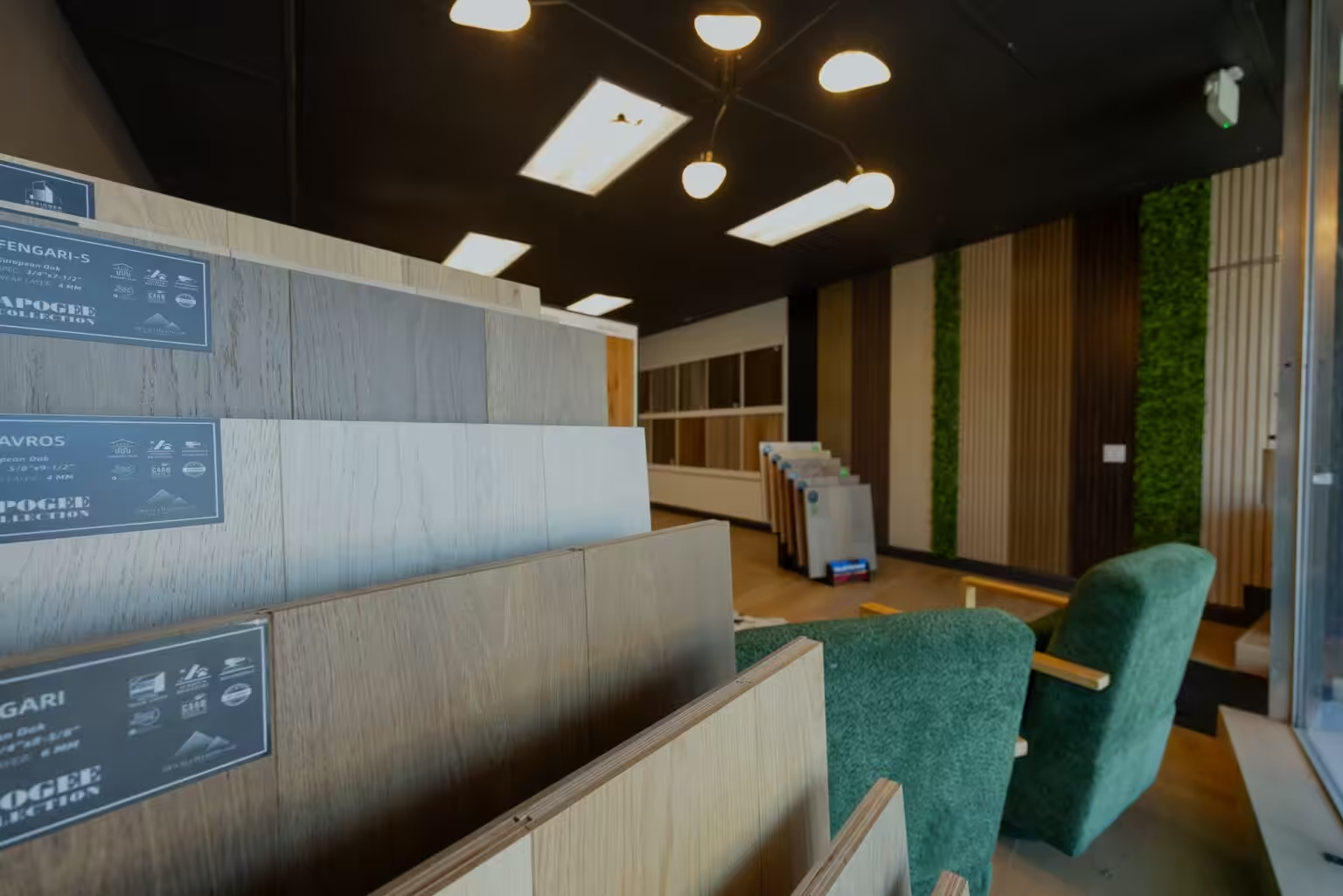
A 9½-inch board does not just look bigger than a 5-inch board. Under the same change in indoor humidity, it also moves about 1.9 times as far across its width, because wood moves in proportion to its size. That one fact sits behind most of the trade-offs below.
In short, the pros of wide plank flooring are fewer seams, more of the wood’s grain on every board and a calmer look in large rooms. The cons are more movement per board, a flatter subfloor, stricter fastening rules once boards pass 7 inches, more cut pieces in small rooms and a higher cost per square foot.
What counts as wide, using the boards on our shelves
There is no official cutoff, so here are the real widths in the lines we stock, taken from their spec sheets. Most shoppers call anything from about 7 inches up “wide.”
| Width | Lines we carry | Lengths and thickness |
|---|---|---|
| 5″ | Denali The FIVE Collection | Random lengths up to 75″; 9/16″ thick |
| 6-1/2″ | Chesapeake Estuary | Random lengths up to 48″; 3/8″ thick |
| 7-1/2″ | Chesapeake Points East and Chemistry, Denali Architect and Tribeca, Aged Wide Floors Hamptons, New York and Legacy, PermWood European White Oak | Up to about 75″; 1/2″ to 5/8″ thick |
| 8-5/8″ to 8.67″ | Chesapeake Cromwell, Denali Mason, Renaissance and Apogee (Fengari), Aged Wide Floors Designer | Up to 87″; 5/8″ to 3/4″ thick |
| 9-1/2″ | Denali Eterna, Cherokee and Apogee, Aged Wide Floors Designer, Symphony | Up to 87″; 5/8″ to 3/4″ thick |
| 190, 240 or 290 mm (about 7.5″, 9.4″ or 11.4″) | Sienna River Collection | 2,130 or 2,450 mm long (about 84″ or 96″); 14.2 to 22 mm thick |
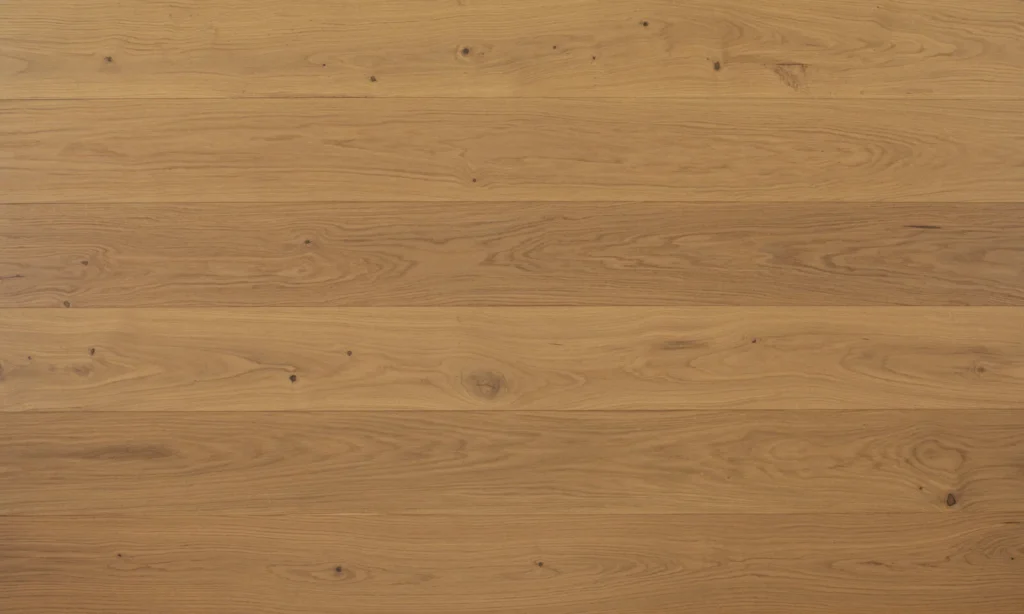
Wide boards are not only a hardwood look. Our wide-plank laminate, Chesapeake Fusion Design XL, comes in 9.3″ by 72″ planks.
The upside: fewer seams and more grain per board
Width cuts the number of long seams roughly in half. Across a room 12 feet wide, 5-inch boards take about 29 rows; 9½-inch boards take about 16. Fewer lines running down the room read as calmer and more open, which is why wide boards suit big living areas and open plans.
Each board also shows more continuous grain, knots and color change, so the floor looks less like a pattern and more like lumber. Longer lengths help the same effect: several of the 8-5/8″ and 9½” lines we carry run up to 87 inches, so end joints show up less often.
The trade-offs, and what causes each one
Each drawback has a mechanical cause, which also tells you how to manage it.
- More movement per board. The USDA’s Wood Handbook calculates shrinkage and swelling as the board’s dimension times a coefficient times the change in moisture content. Double the width and you double the movement, so seasonal gaps and tight joints show more on wide boards.
- A flatter subfloor. A long, wide board bridges dips that narrow strips would follow. The Chesapeake manuals we read ask for a subfloor flat to within 3/16 inch over 10 feet.
- Stricter fastening. Denali’s installation guide requires glue assist for planks wider than 7 inches when cleats or staples are the main fastener.
- More cut pieces in small rooms. In a narrow hall or powder room, only a few full boards fit across, and the rest are rips and short ends.
- Higher cost per square foot. Price moves with width, length, species, the thickness of the top layer and the finish, so compare quotes for the same width and grade.
Why most of the wide boards we sell are engineered
An engineered board puts a real-wood top layer over a cross-layered core, and the layers running in different directions restrain each other.
That is why the wide planks in the table above are engineered: the core keeps a 9½-inch board steadier than a single piece of wood that wide would be. You can compare them in our engineered hardwood collections.
Decision table: which width suits which room
Use this as a starting point, then confirm against the spec sheet of the product you like.
| Your situation | 5″ to 6-1/2″ | 7-1/2″ | 8-5/8″ and wider |
|---|---|---|---|
| Open plan or a long living room | Works; more seams | Good fit | Best showcase |
| Small bedroom, hall or powder room | Good fit | Good fit | Many cut pieces |
| Subfloor not yet checked for flatness | More forgiving | Check it first | Flatten before ordering |
| Nail or staple over plywood | Per the sheet | Per the sheet; Denali needs glue assist above 7″ | Glue assist on the Denali lines |
| Home where indoor humidity swings | Least visible movement | Moderate | Keep humidity in the maker’s range |
Checklist before you order wide planks
Print this and bring it to the store or the job site:
- ☐ Room size measured, and the direction the boards will run decided.
- ☐ Subfloor checked with a straightedge against the sheet’s flatness rule (3/16 inch over 10 feet in the manuals we read).
- ☐ Installation method confirmed for this width: glue, nail with glue assist, staple or float.
- ☐ Grade level confirmed: on, above or below grade, as the line allows.
- ☐ Radiant heat approval checked, if the floor is heated.
- ☐ Indoor humidity plan for the life of the floor: Chesapeake and Denali both ask for 35% to 55% relative humidity.
- ☐ Waste allowance added to the order: Chesapeake suggests 5% on engineered hardwood, more for diagonal or pattern layouts.
- ☐ A full-length sample seen in person, since one small chip cannot show a 9-inch board’s grain.
Bring the checklist to a showroom visit, where you can stand next to full-size display boards, or start by browsing the engineered collections that come in 7-1/2″ and wider.


0 Comments