
The best flooring for a humid climate, among the floors we sell, is rigid-core SPC vinyl plank. Damp air doesn’t swell the plank, and the PermShield manual behind most of our SPC lines even covers a seasonal cottage left closed.
Engineered hardwood is the real-wood pick when the air conditioning runs all summer and holds the room between 35% and 55% relative humidity. Laminate, including the lines sold as waterproof, belongs only where temperature and humidity are controlled all year.
Those three answers cover a lot of floor: our online catalog lists 266 floors, made up of 220 engineered hardwoods, 25 laminates and 21 SPC vinyl planks. Each family asks something different of the air inside your house, and the manufacturers put it in writing.
Damp air is a different test from spilled water
A “waterproof” label tells you what happens when water sits on top of the floor. A humid climate tests something slower: what the material does when the air around it stays damp for weeks, and what happens when the AC is switched off.
The label doesn’t answer that second question. We explain what the labels themselves promise in waterproof vs. water-resistant flooring; here the subject is the air.
The humidity window each floor’s manual sets
We read the installation documents of the lines below and pulled out what a humid climate cares about: the conditions the floor needs for the rest of its life. Where a document sets no number, the table says so.
| SPC vinyl plank (PermShield One Plus and Lite) | Laminate (Chesapeake Fusion Design XL, All American Premium) | Engineered hardwood (Chesapeake, Denali, Hallmark) | |
|---|---|---|---|
| Temperature the manual asks for | HVAC set at 65–85°F during and after installation; 55–100°F while an enclosed seasonal room is in use | 65–85°F before, during and after installation | 60–80°F |
| Indoor relative humidity | No indoor range in the manual; it sets limits for the slab only | 30–50% | 35–55% (Chesapeake, Denali); 30–55% (Hallmark, 35–55% for hickory) |
| House closed with the AC off | Allowed in fully enclosed seasonal cottages and sunrooms: -20°F to 176°F while unoccupied | Not allowed: never where temperature and humidity aren’t controlled year-round | Not allowed: Denali says never turn the HVAC off while you’re away |
| Fits a humid house when | Almost always; the subfloor still has to be dry and flat | The room is conditioned every month of the year | The AC or a dehumidifier holds the humidity window through summer |
Sources: PermShield rigid core installation instructions and PermShield luxury vinyl flooring warranty (both revised September 1, 2023); Chesapeake laminate installation guidelines and engineered hardwood installation guidelines (June 1, 2025); Denali engineered hardwood installation guidelines (revised January 19, 2026); Hallmark engineered wood installation instructions.
One difference between the PermShield documents: for a seasonal room in use, the manual allows up to 100°F while the warranty says 95°F. Plan around 95.
The two floors in these photos, and what we know about each
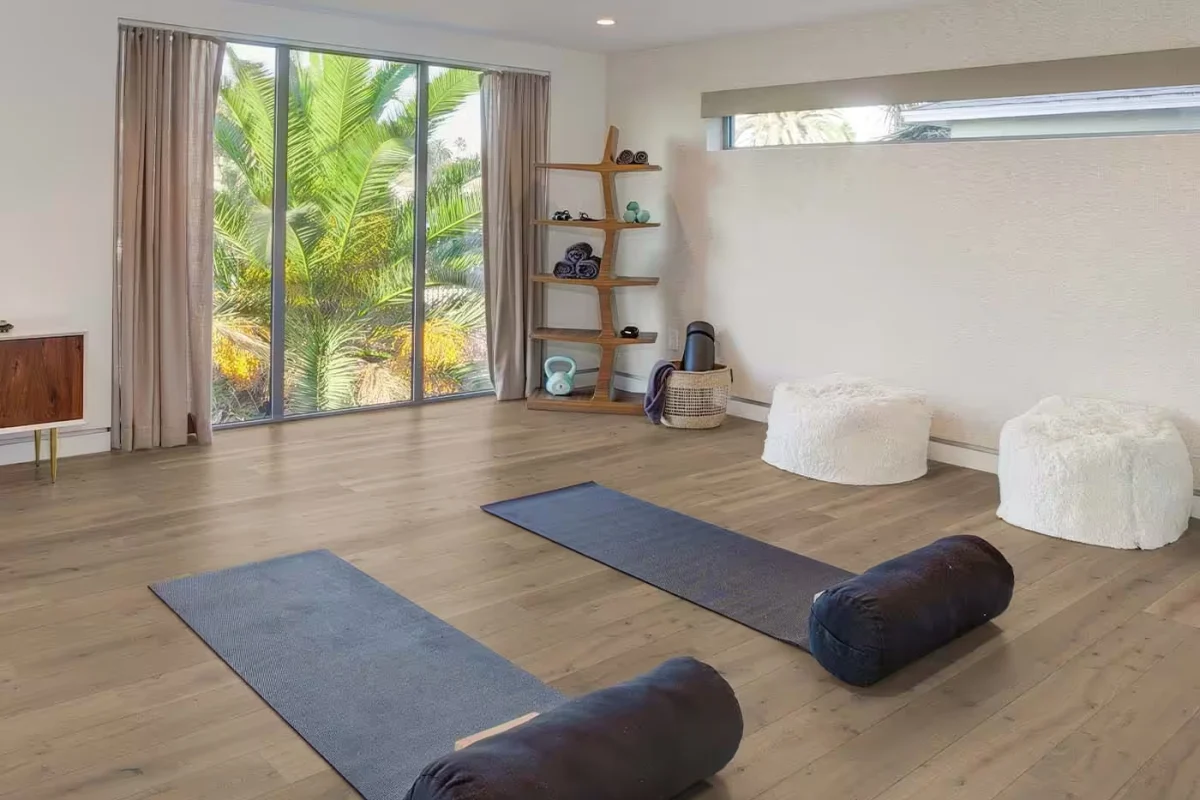
The photo at the top of this page is the Sienna River Collection in Volta, a fumed Western European oak sold as engineered flooring in 190, 240 and 290 mm widths.
The room in that photo has a wall of glass looking onto palms, which is a fair picture of the risk: a real-wood top layer reacts when the air inside drifts toward the air outside. We don’t have Sienna’s own installation sheet on file, so ask us for it before you order.
Among the engineered manuals we did read, Chesapeake’s names the humid season directly and lists the tools: an air conditioner, a dehumidifier, or turning the heating system on now and then during the summer months.
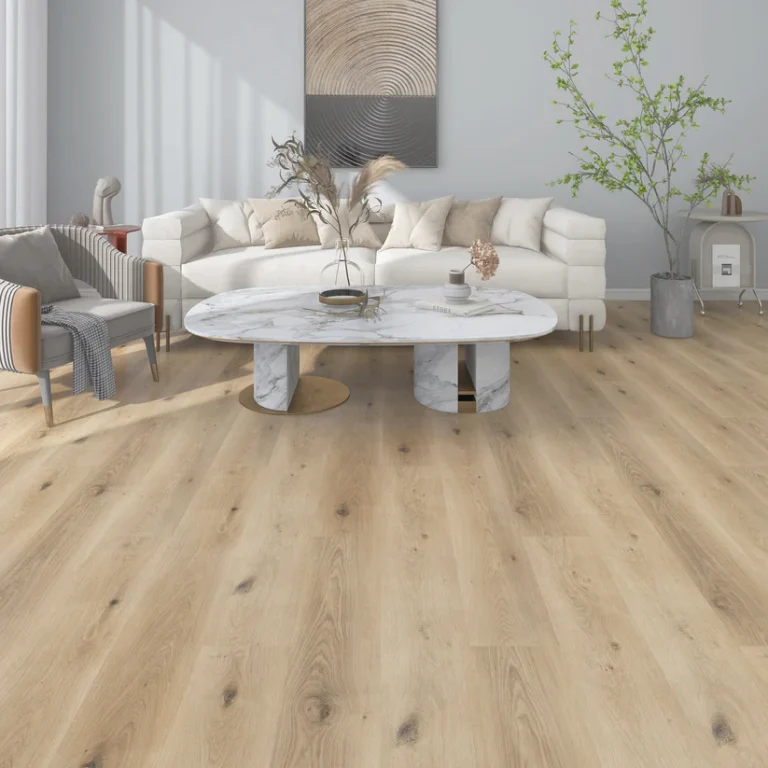
This second photo shows Belocore SPC in Latte. It looks like the same light oak, but the core under the printed layer is an SPC (stone plastic composite) recipe, with no wood fiber in it.
The SPC row in the table comes from the PermShield manual, not from Belocore. Ask us for Belocore’s own sheet before it goes into a house that will sit closed.
Crawl space or slab: what the manuals ask underneath
Humid air is only half of it; moisture also comes up from below. The manuals we read set rules for both kinds of house.
- Raised house over a crawl space: PermShield asks for at least 18 inches between the ground and the joists, perimeter vents equal to at least 1.5% of the crawl space area, and black 6-mil polyethylene over the entire ground, seams overlapped 6 inches and taped. Chesapeake’s laminate and engineered guidelines also ask for 18 inches of well-ventilated space and 6-mil poly over the ground.
- Concrete slab: PermShield requires 6-mil polyethylene under its floating floors on concrete at or below grade, and caps the slab at 90% internal relative humidity (ASTM F2170). Chesapeake’s engineered guidelines set 75% and call for a vapor retarder above that.
Every one of those numbers is measured before the floor arrives. Our guide to the best flooring for a concrete slab walks through the slab tests.
Which floor fits which kind of humid house
The same climate produces very different houses. Find the line that describes yours.
A beach house, rental or second home that sits closed in summer
Choose SPC. Of the documents we read, it is the only one written for a house left without climate control: PermShield allows its planks in fully enclosed seasonal cottages and three-season rooms, rated for -20°F to 176°F while unoccupied.
One condition comes with it: the installation itself happens with the HVAC running at 65–85°F. The waterproof SPC flooring we stock in North Charleston is where to start for a house like this.
A house you live in all year, with the AC running
Here you have a real choice. Engineered hardwood suits the living room and bedrooms if the system holds 35–55% through the humid months; SPC suits the kitchen, the laundry and the rooms where wet feet come in.
If wood is the plan, start before the floor arrives: our guide on how to acclimate engineered hardwood covers the 14 days of running HVAC that Chesapeake asks for.
Upstairs bedrooms on a tighter budget
Laminate can work where the air is conditioned every month. Chesapeake’s laminate manual allows 65–85°F and 30–50% relative humidity and says laminate should never go into an area without consistent year-round temperature and humidity control.
The “waterproof” printed on our Chesapeake laminate lines covers spills on the surface. It doesn’t widen that humidity window.
A sunroom or enclosed porch room
Choose SPC, for the same reason as the closed beach house: the PermShield manual names solariums, sunrooms and three-season rooms. Laminate and engineered wood need the year-round climate control a three-season room doesn’t have.
A ground floor in a flood zone
That is a different question from humidity, with its own federal rules. We answer it separately in our guide to flooring for flood-prone areas.
Keeping a wood or laminate floor inside its window
A humid climate isn’t humid all year. The floor sees two seasons, and each one pushes it a different way.
- Summer: keep the AC on, even when nobody is home. Denali’s guidelines warn that switching the HVAC off during a vacation can leave you with a floor that has cupped, buckled or gapped.
- Winter: heated air dries out. Chesapeake recommends a humidifier in the heating season to prevent excessive shrinkage in wood floors.
- All year: a hygrometer in the room shows the number before the boards do. Compare it with the range on your line’s own sheet, since Hallmark’s lower limit (30%) differs from Chesapeake’s and Denali’s (35%).
Tile and solid hardwood, which we don’t carry
Porcelain tile and solid hardwood come up in almost every discussion of floors for humid climates. Neither is in our catalog, so here is only what their industry bodies publish.
The Tile Council of North America defines porcelain as tile that absorbs 0.5% water or less (ASTM C373). The National Wood Flooring Association notes that engineered floors expand and contract less than solid wood, and that solid wood can go in rooms on or above ground level.
If tile is the right answer for a shower or a mudroom, a tile supplier is the better stop for that room.
Quick answers
Which flooring type is the most water resistant?
Among the floors we sell, SPC vinyl plank: water on top doesn’t hurt the plank. PermShield’s warranty still states that luxury vinyl plank is not a moisture barrier, so water that gets underneath is a subfloor problem.
Why does my floor feel damp in summer?
Often it is the floor being cooler than the air. PermShield notes that a concrete floor can run up to 10°F colder than the room, and warm, humid air leaves moisture on surfaces cooler than its dew point. Running the AC or a dehumidifier lowers the dew point of the room.
What moves the price of a floor for a humid house
We don’t print prices because they change; a quote is built from these parts:
- The family and the line: SPC wear layer and attached pad, laminate thickness, or the engineered species, width and top-layer thickness.
- Square footage plus cutting waste, and a spare carton kept for repairs.
- Subfloor work: moisture testing, leveling to the manual’s flatness, and 6-mil poly over concrete where the line calls for it.
- Moldings, transitions and stair parts.
If the house will sit closed for part of the year, start with SPC and see the waterproof SPC lines we carry. Then bring the room sizes, and whether the AC runs all summer, to our showroom in North Charleston, (843) 823-7887, or Richmond, (804) 905-7438, or send them through our contact page.
0 Comments