

A floating floor locks plank to plank and rests on the subfloor without being fastened to it. A glue-down floor is bonded to the subfloor with adhesive. For many of the floors we sell, the manufacturer has already narrowed the choice, so what is left to decide is smaller than most comparisons suggest.
Float when the product allows it, nothing heavy or rolling sits on it, and you’d like to be able to lift the floor after a leak. Glue when the maker requires it: that covers every Denali color we carry, and any room where office chairs, wheelchairs or a safe will sit on SPC vinyl.
What our catalog allows, line by line
We read the installation field on every flooring product page on our site, 266 products in all, and the installation documents behind them:
| Line (products on our site) | Float | Glue | What the maker adds |
|---|---|---|---|
| PermShield Lite and One Plus SPC vinyl (18) | Yes, by design | Yes, over approved wood and concrete | Glue is required under rolling loads and very heavy objects |
| Belocore SPC vinyl (3) | Not stated | Not stated | 1 mm pad attached; ask for the sheet |
| Chesapeake laminate: All American Premium (13), Fusion Design XL (12) | Yes, click | No glue-down method in the guidelines | Moldings are never fastened to the floor |
| Veranda Asheville and Charleston (21) | Yes | Yes, or staple | Above, at or below ground level |
| Chesapeake Cromwell (12) and one Points East color | Yes | Yes, or nail or staple | Floating needs 6-mil poly, closed-cell foam and PVAC glue in the joints |
| Chesapeake Chemistry (9) | No | Yes, or nail or staple | On or above grade |
| PermWood LaBelle (2) | No | Yes, or nail or staple | 4 mm wear layer |
| Denali (43) | Not on our pages | Glue-down or glue-assisted nail-down | Its manual floats only 1/2″ to 9/16″ boards with up to a 3 mm wear layer |
| Not stated on our pages: Aged Wide Floors (56), Hallmark (24), Sienna River (27), Symphony (12), other Points East and Estuary colors (13) | Ask | Ask | Hallmark’s manual allows glue or float on concrete at or above grade |
Counted up, all 25 laminate products are click floors; PermShield’s 18 SPC products float by design, with glue as an approved alternative; Belocore’s 3 SPC products don’t state a method on the page.
On the engineered side, only 34 of 220 products list floating on their page, 54 list glue, nail or staple without floating, and 132 don’t state a method yet. For those, ask us for the manufacturer’s sheet before you plan anything.
What each method adds to the order
The method changes the shopping list as well as the labor, so the quote moves with it:
- Floating SPC (PermShield): the pad is already on the plank; on a slab on or below grade, add 6-mil polyethylene with taped seams.
- Glued SPC (PermShield): an approved adhesive (its manual names Shaw 200, 1500 and 4100 or comparable), the trowel the adhesive calls for, and a 100-lb three-section roller used right after the planks go down.
- Floating engineered (Chesapeake): 6-mil poly with seams overlapped 16 inches and taped, closed-cell foam, and waterproof PVAC glue run along the tongues.
- Glued engineered: a urethane or cross-link wood flooring adhesive for Chesapeake; urethane- or polymer-based with a moisture vapor protection system for Denali.
Mistake 1: Choosing the method before reading the product
No installation plan survives a board that can’t float. All of the Denali colors on our pages are glue-down or glue-assisted nail-down, and Chemistry lists glue, nail or staple. Cromwell and the Veranda lines can float. The product page and its installation sheet come first; the method follows from them.
On concrete, the adhesive’s own rules take over for glued wood. We compared what three engineered manuals require on a slab in engineered hardwood on a concrete slab.
Mistake 2: Floating a floor under rolling chairs, wheelchairs or a safe
On PermShield SPC, rolling loads are a glue-down job, not an option. Its manual says installations that will see rolling casters, movable racks, wheeled displays, or power or manual wheelchairs must be glued to the substrate.
The same manual warns that heavy loads can pin a floating floor so it can’t expand and contract evenly, causing separation, peaking or gapping, and asks for glue where objects such as safes will sit.
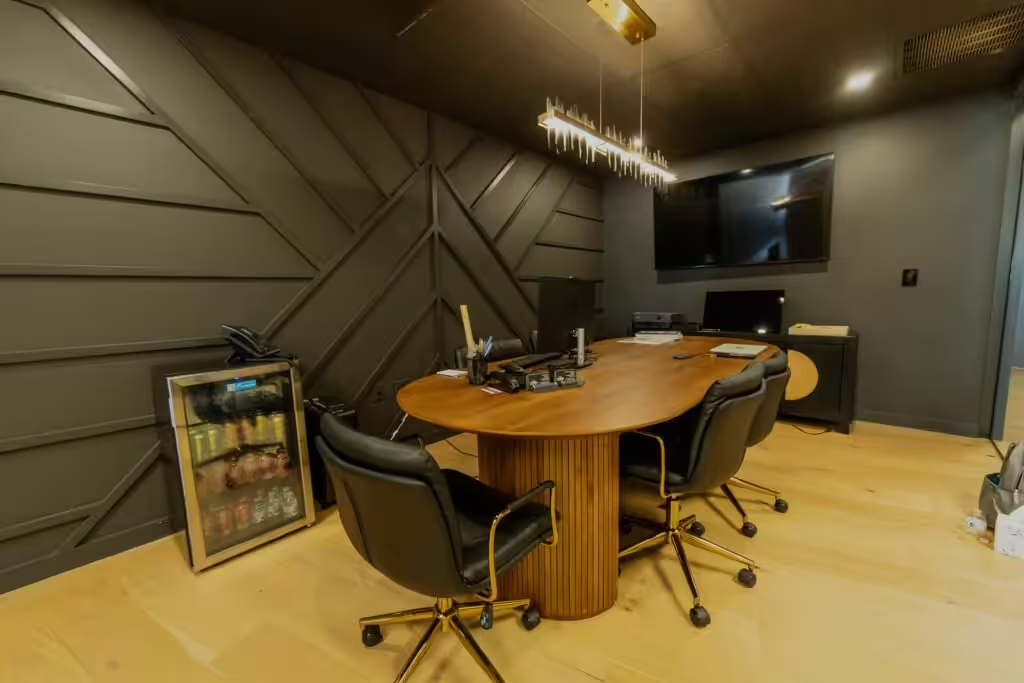
Laminate has no glue-down route, so the protection moves to the furniture. Chesapeake’s guidelines call for protective mats under caster chairs, wide non-staining casters at least 2 inches across, furniture weight evenly spread up to 400 pounds, and point loads under 100 pounds each. Its laminate warranty excludes damage from rolling caster chairs and other rolling loads.
Mistake 3: Pinning a floating floor in place
Floating floors have to move with the seasons.
PermShield, Chesapeake and Hallmark all say cabinets and islands go in before the floor and never on top of a floating installation; Hallmark warns that building on top of a floating floor can lead to buckling, bounce and squeaks. Moldings are fastened to the wall, and nothing is fastened through the planks.
The perimeter gap is part of the system: PermShield asks for 1/4 inch on areas up to 2,500 sq ft and 1/2 inch beyond that; Chesapeake asks for 3/8 inch on its laminate, with more expansion past 40 feet. Doorways are where these rules meet, and we went through them in flooring transitions between rooms.
Glue-down is more tolerant here, but not unlimited. Hallmark says cabinets on top of a glued or nailed floor don’t void its warranty, yet it won’t cover the cost of removing them if the floor ever needs repair.
Mistake 4: Expecting glue to forgive a bad subfloor
Gluing doesn’t relax the prep. PermShield asks for a subfloor flat within 3/16 inch per 10-foot radius whichever way its planks go down, and Chesapeake asks the same of its engineered floors.
A glued SPC floor still keeps its 1/4-inch perimeter gap, and the adhesive label, not the flooring manual, sets the moisture limit, as PermShield points out.
The bond is its own warranty, too. Denali says moisture and bond-release claims on its glued floors fall under the adhesive manufacturer’s warranty, and Chesapeake tells installers not to spread more adhesive than they can cover within 20 minutes.
Mistake 5: Assuming floating means noisy and glue means silent
Movement is what makes noise, and either method can move. PermShield’s warranty states that its floors aren’t warranted against squeaking, popping or crackling and that some is possible with floated installations; Hallmark links bounce and squeaks on floating floors to cabinets and other things built on top of them.
Adding foam isn’t the fix either. PermShield reports that lab tests for impact and airborne sound on some of its vinyl showed no added benefit from a second underlayment, and Chesapeake allows no extra pad under laminate that already has one. We cover the vinyl side in underlayment for vinyl plank flooring.
Mistake 6: Gluing where the manual says float
Radiant heat flips the usual logic. Chesapeake allows its engineered floors over radiant heat only as a floating installation, only over hydronic systems, with the floor surface kept at or below 80°F, and only its pre-installation and structural warranties apply there.
PermShield allows its SPC over embedded radiant heat with the surface never above 82°F, and not over wire mat systems.
Mistake 7: Gluing a floor you may need to lift
Click floors can be taken apart: according to PermShield’s manual, the end joints release when the planks slide apart sideways, so rows can come up after a leak and the subfloor can dry. A glued floor doesn’t lift in rows.
In rooms where water is likely to get underneath someday, that difference matters more than any feel underfoot; we walked through the drying decisions in flooring after water damage.
If you want a floor that can come back up, compare our click-together SPC vinyl plank lines; if office chairs will roll across it, ask us for PermShield’s direct-glue instructions along with the quote. Either way, the method is settled by the product page before the first carton is opened.


0 Comments